A DLC V6.0 upgrade for an existing indoor linear luminaire starts with a gap review: identify the applicable requirements, connect them to the product being sold, and determine whether the next step is documentation, a targeted redesign or a different platform. Buying a new diffuser or driver before that review can commit the project to a change that does not address its main limitation.
For US and Canadian lighting brands and OEMs, the review should lead directly to an engineering brief. That brief connects the present configuration, the qualification target, the parts that must remain and the evidence needed for the revised product. Felix can support the optical and mechanical work within that scope; testing and application responsibilities need named owners.
Requirements and transition information reviewed September 22, 2026.
Confirm the product category and qualification target
“Linear” describes a shape. DLC evaluates a product against its applicable Primary Use Designation, or PUD. An office pendant, a utilitarian strip fixture and a linear high-bay therefore need separate category decisions, even when their housings are all long and narrow. The review should record the current model, DLC product ID if available, PUD and Standard or Premium target.
The final requirements explicitly exclude utilitarian strip-style fixtures from the two Linear Ambient definitions. Those products need their own eligibility assessment. Similarly, some uplight does not automatically place a luminaire in the indirect Linear Ambient designation: its definition includes a distribution condition. Appendix A of the DLC technical requirements is the starting reference for that classification.
The configuration matters as much as the model name. A report for one diffuser, power setting or control option does not establish the performance of another sales option. Record the LED board, driver, optical part, CCT, operating setting and housing revision behind the baseline report before comparing it with a target.
Choose the application route before planning the redesign
The current transition has two different dates. October 9, 2026 is the deadline for submitting transition update applications; December 15, 2026 is the scheduled delisting date for remaining V5.1 products. The DLC’s September reminder states that updates submitted after October 9 will be processed as new applications, with the necessary reports, documentation and new-application fees. Submission by the deadline does not itself establish qualification. See the official reminder and transition guidance.
The simplified transition process excludes elective product-performance changes and new models. A product team planning a different optical system, LED arrangement or driver should therefore resolve the applicable application route alongside the engineering scope. Provisions for an unchanged product cannot simply be assumed to cover a redesigned one.
A useful early decision separates configurations that will remain unchanged from those being revised. For a family with several lengths or optical options, the same application and testing assumptions may not apply across the range. The laboratory and application owner should assess that distinction before sample quantities and submission timing are committed.
Separate missing evidence from a measured performance gap
A missing configuration reference and a demonstrated failure call for different work. If a report does not identify the installed diffuser, the immediate problem is traceability. If a matching report shows insufficient luminaire efficacy for the correct category and target, there is a measured gap to investigate. Changing the product will not resolve an unidentified baseline.
| Finding | Useful next step | What would be premature |
|---|---|---|
| Report and sales configuration cannot be matched | Reconcile model suffixes, components and report references | Selecting a new optic from an uncertain baseline |
| Matching report shows an efficacy shortfall | Investigate source, driver, thermal and optical contributions | Assuming the diffuser accounts for the whole gap |
| Distribution does not suit the intended application | Review photometry, layout and the proposed optical arrangement | Treating a higher lm/W value as a complete solution |
| Control option is unclear or unsupported | Identify the actual driver, accessory, interface and capability | Equating spare housing space with a controls qualification |
| Earlier evidence describes a different assembly | Assess which changes affect testing and documentation | Carrying all previous claims into the revised model |
Three engineering routes follow from this review. Documentation work suits a product whose actual performance and evidence already meet the target but whose application package needs completion. A targeted redesign suits an identifiable limitation that can be addressed within the retained platform. A new housing or platform becomes a candidate when the required arrangement cannot fit the fixed constraints.
These are scope decisions, not guarantees of a particular submission route or number of tests. The DLC product-update guidance ties supporting information to the extent of the change. Keeping the outside of a luminaire unchanged does not make an internal optical or electrical change immaterial.
Build a redesign brief around the conditions that must stay
The first discussion can begin with the product type, model, current problem and target. Detailed review then needs the available specification sheet, product photographs, section and assembly drawings, component references, photometric report and IES file. Relevant thermal or lifetime documents should keep their tested-configuration references. Missing information should be listed explicitly rather than replaced with data from a similar model.
Physical limits make that evidence actionable. An office linear system may need to retain its suspension positions and continuous-run appearance. A strip or industrial luminaire may need to preserve its sheet-metal tooling, mounting interface or electrical access. Distinguish fixed conditions from preferences: preserving the exterior dimensions is a different requirement from preserving every internal carrier and fastener.
Consider a planning example, rather than a completed Felix project: an OEM wants to retain an existing wraparound housing but is willing to change its diffuser and LED mounting arrangement. The brief needs the retaining interface, board position, available cavity and required output. Those inputs make it possible to compare a replacement cover with a local carrier change. The statement “keep the housing” alone leaves both options poorly defined.
Project priorities belong in the same brief. Retaining tooling, minimizing new parts and supporting multiple optical options can lead to different proposals. Actual quotations and prototype findings should determine the trade-off; no route carries an automatic cost or timing advantage. The linear luminaire cutsheet checklist provides supporting specification context.
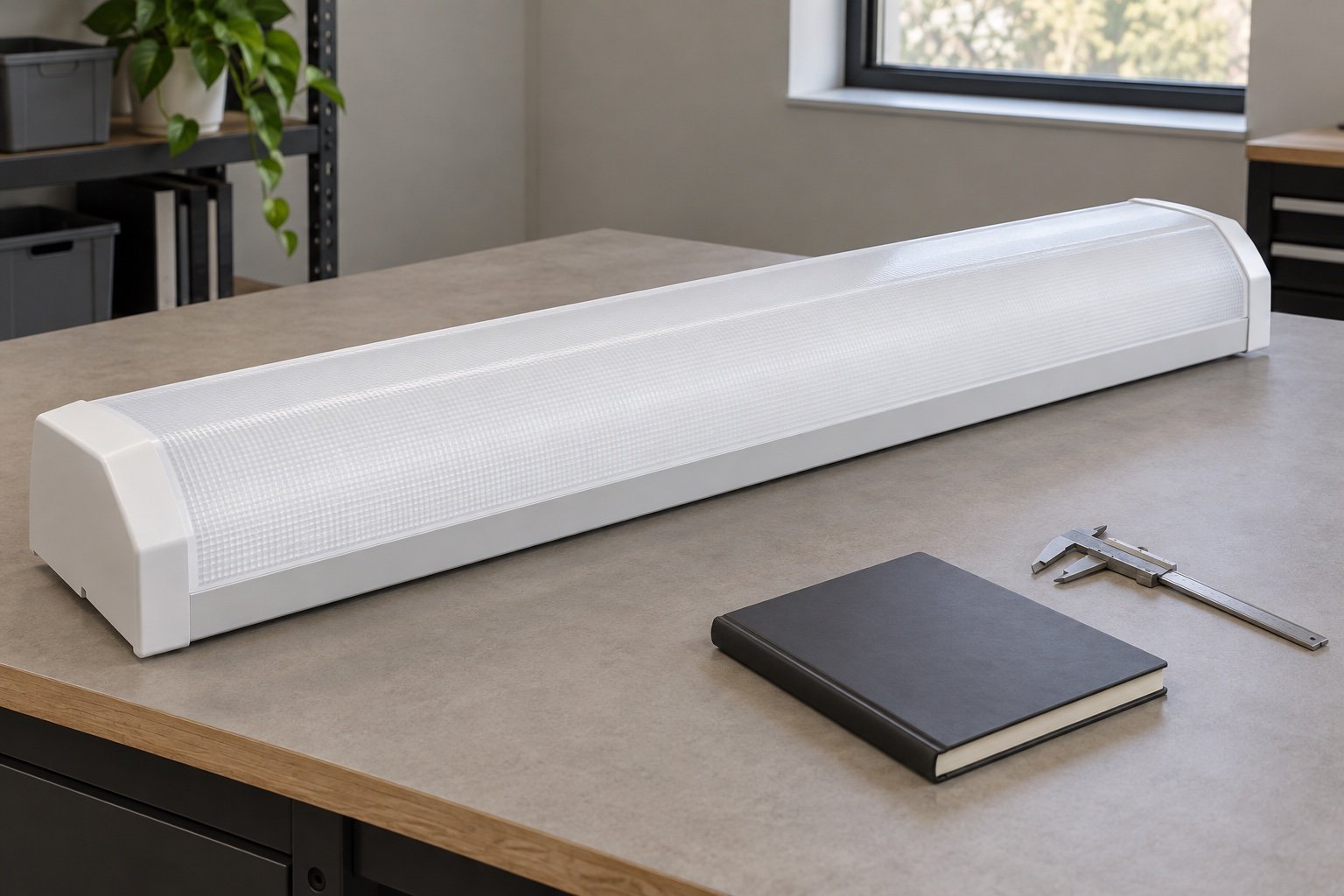
Agree the optical and mechanical deliverables
Felix provides optical and mechanical design support. Depending on the agreed project, deliverables can include optical selection or design information, revised sections and assembly drawings, critical dimensions, component references and a change list. The scope should state what each deliverable is intended to resolve and what evidence will still be needed.
| Deliverable | Question it can address | Further verification |
|---|---|---|
| Revised section or assembly drawing | How will proposed parts fit, locate and assemble? | Prototype fit, assembly access and applicable performance testing |
| Optical proposal | Which arrangement is worth developing for the intended distribution? | Complete-luminaire photometry and application comparison |
| Prototype and controlled component list | What physical configuration is being evaluated? | Reports tied to that exact sample and operating setting |
| Change list and evidence review | Which earlier assumptions and reports need reassessment? | Agreement with the laboratory and application owner |
This distinction prevents a drawing from being treated as proof of efficacy, or an assembly sample from being treated as a qualification result. Where custom profile work is involved, the profile quotation checklist supplies additional drawing and procurement context. The DLC brief still needs its own performance targets and validation plan.
Connect the prototype, test plan and application handoff
Before testing, the sample identifier should connect to the drawing revision, component list, optical option and electrical settings. A change after testing needs an impact review before the revised configuration inherits the earlier evidence. A short, consistent revision record is more useful than several files called “final.”
The brand or OEM owns the target, sales configurations and product decisions. Felix’s responsibility is the optical and mechanical work included in the agreed scope. The laboratory handles the agreed tests and reports, while the application owner coordinates the applicable route, documents, submission and reviewer responses. One company may hold several roles, but engineering support should not be assumed to include testing or application submission.
The final handoff should reconcile model numbers, specification sheets, drawings, component references and report identifiers. The DLC common-issues guide is a useful document check. Production purchasing and assembly should then use the intended configuration so that a later substitution does not silently change the evaluated product.
Discuss a DLC linear lighting upgrade with Felix by sending the product type, current model and DLC product ID if available, the target level, main problem and conditions you want to preserve. Available drawings and reports can follow by email. That information is enough to begin defining the optical and structural work and the questions that need laboratory or application review.