

“UGR diffuser” is a convenient market label, but it can lead to the wrong specification decision. A diffuser plate, prismatic optic or louvre can change how a luminaire emits light. The resulting Unified Glare Rating still depends on the luminaire photometry, the room, the observer position and the viewing direction used in the calculation.
The practical question is whether the complete luminaire has suitable optical evidence and whether the proposed installation is assessed using the method and glare criterion agreed for that project. A material label alone cannot establish that result.
What UGR represents
UGR is a method for assessing discomfort glare from luminaires in an indoor installation. It considers the apparent luminance and size of glare sources, their positions in the observer’s field of view and the background luminance. Standard tabular presentations use defined room and surface assumptions; a project calculation uses a particular layout and observer geometry.
This is why one luminaire can produce different UGR results in different arrangements. A change in mounting height, spacing, room proportions, surface reflectance or viewing direction can alter the result even when the product is unchanged.
Keep tabular UGR and project point calculations distinct. The 2019 CIE-session paper by Vissenberg and colleagues explains why arbitrary point values are not directly interchangeable with limits derived using the tabular method. This is a research discussion, not a substitute for the applicable project requirements: identify the evaluation method, room assumptions and acceptance basis before comparing a result with a limit.
Separate direct glare from a reflected image
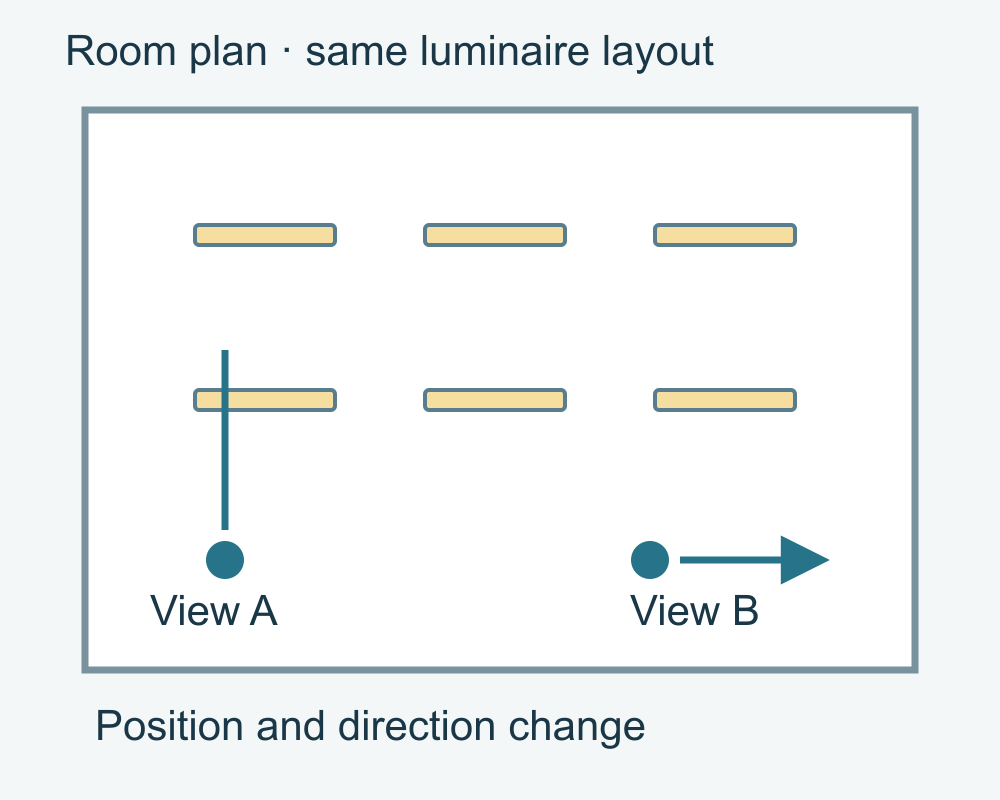
Ask where the discomfort occurs. Is the occupant looking towards a bright luminaire aperture, or seeing its image in a screen or another glossy surface? ERCO’s explanation of the UGR method makes the distinction explicit: UGR addresses direct discomfort glare from luminaires, rather than reflected glare from surfaces. A screen-reflection complaint therefore needs its own review of positions, viewing direction and surfaces, even when a UGR result is available.
A useful site record includes a room plan, the occupied position and the direction in which the problem is seen. A close-up of the diffuser alone removes the relationships that may explain the complaint.
What a diffuser or louvre can change
An optical plate can spread, redirect or shield emitted light. Depending on its design and its relationship to the light source, it may reduce high-luminance views at critical angles or make the luminous aperture appear more uniform. A louvre may restrict light at selected angles; a diffusing plate may broaden and blend the distribution.
Each intervention has consequences. Shielding and diffusion can change the intensity distribution and delivered light, so comparisons need photometry for the actual luminaire and optic. An intensity file describes directional output; it does not automatically describe every brightness variation across the luminous surface.
Compare the optical role before the marketing label
| Optical option | What to examine in the complete luminaire |
|---|---|
| Opal or other diffusing cover | Source hiding, aperture appearance, intensity distribution and delivered light. A smooth luminous surface does not establish a project UGR result. |
| Microprismatic optical plate | Exact plate design, orientation and measured distribution for the assembly. Do not assume two visually similar patterns control the same angles. |
| Louvre or recessed shielding | Visibility of the light source from occupied positions, distribution and the lighting task. Shielding can change which views matter. |
These are questions for comparing evidence, not a ranking of materials. An optic that is suitable for one aperture, source arrangement and room can be unsuitable for another. Keep visual uniformity, useful illumination and discomfort-glare assessment as separate entries in the comparison so that an improvement in one is not mistaken for success in all three.
What it cannot fix by itself
Changing the plate may improve some views, but it does not by itself guarantee a solution to glare associated with output, layout or viewing geometry. Check those variables together and use evidence for the assembled luminaire. A plate change alone is not proof that a project criterion has been met.
Nor should UGR replace a broader visual-comfort review. Reflections on screens, direct views of the light source, contrast, flicker, task geometry and adaptation conditions may still affect the experience even where a calculated criterion is met.
Evidence to request
Ask the supplier to identify the exact tested configuration: housing, light source, output level, driver setting and optical component. Request the photometric file for that configuration and check that its product code matches the quotation and sample.
For a specification decision, record:
- luminous flux and power for the tested assembly;
- intensity distribution or photometric file;
- dimensions and luminous aperture;
- optic or diffuser code and finish;
- any tabular UGR presentation and its assumptions;
- project calculation assumptions, observer positions and viewing directions;
- differences between the sample, calculation file and final order.
A generic “UGR<19” statement without configuration and calculation context is not enough to reproduce the result.
For a non-uniform luminous surface, ask which source-area and luminance assessment applies. The official description of CIE TN 014:2023, Example Luminance Measurement Setup for UGR, explains the use of HDR luminance images for the CIE 232 supplement. Where that route applies, a conventional intensity file alone is insufficient documentation.
Read the conditions around the number
A UGR table needs its context. TRILUX’s table-method guide identifies standardised room proportions, luminaire arrangements, surface reflectances and observing conditions. It also distinguishes the viewing direction parallel to the luminaires from the direction across them. Those headings and assumptions belong in the evidence package with the result.
Before accepting a supplier comparison, check that the report identifies the same luminaire and optic code as the quotation, states the output used, and includes the room and observer assumptions. If one result is a standard table value and another comes from a particular room simulation, ask the designer to establish an appropriate basis for comparison. Do not select whichever isolated number is smaller.
A practical comparison procedure
First compare candidate luminaires against equivalent task-lighting requirements. Agree the evaluation method and criterion with the project team, then use consistent room geometry, reflectances, output assumptions and observer positions. Review the distribution and critical views with a physical sample; document both the calculation and any remaining visual-comfort concerns.
If an optic changes, rerun the calculation using the matching photometric file. Do not substitute a visually similar product code. Keep the accepted file and configuration in the submittal so procurement and commissioning can trace the decision.
A controlled comparison example
For a hypothetical office review, label two candidate optical configurations A and B. Give the lighting designer the matching measured data for each. Assess them against the same agreed task and glare requirements, recording any differences in output or layout needed to satisfy the task. Then review physical samples from the occupied positions that matter to the users.
The record should show three separate outcomes: whether the proposed scheme meets the agreed calculation basis, whether useful illumination is suitable, and whether the sample reveals other visual-comfort concerns. This example describes a review process; it contains no calculated UGR values and makes no claim that either sample will pass.
If a supplier cannot provide the configuration identity or the assumptions behind a quoted figure, treat that figure as incomplete evidence. Request the missing items before approving an optical substitution; a promise to “add a UGR plate” is not an equivalent technical submission.
Use the luminaire cutsheet checklist to organise the requested evidence. If visible LED points are also a concern, see how to investigate LED hotspots; visual uniformity and a glare assessment answer different questions.
Ask About Optical Documentation: describe the luminaire, optic, output and project requirement in your enquiry. Ask Felix to confirm what documentation and support are available for that configuration; final project acceptance remains with the responsible project team.
Featured image: concept illustration.

