

Existing luminaires can carry material value, architectural identity and embodied effort. They can also carry unknown wiring, obsolete components and performance that no longer fits the space. A refurbishment team needs more than a general preference for reuse: it needs a recorded decision that connects condition, safety, lighting performance, serviceability and project responsibility.
The useful early-stage question is not “Can we keep it?” in isolation. It is “Which parts of the existing lighting system can continue to perform a defined function, under whose responsibility, and with what evidence?”
Establish the baseline
Begin with an asset survey. Record the luminaire type, quantity, location, physical condition, mounting, electrical arrangement, controls, available documentation and any heritage significance. Photograph labels, drivers, connectors, optics and signs of heat or corrosion.
Then define the future requirement. Required illuminance, distribution, glare control, colour quality, emergency function, controls and maintenance access may have changed since installation. Without this baseline, a reuse decision can preserve the object while failing the project.
Unknown condition is not evidence of failure, but it is a reason to investigate. Electrical safety, regulatory compliance and hazardous-material questions belong with appropriately qualified specialists.
Separate a reusable object from a usable lighting scheme
Record each family of luminaires separately, including its location and available quantity. A fitting can remain physically useful while the new room layout makes its old position unsuitable. Conversely, a tired finish may be repairable even where the housing and mounting arrangement are worth retaining. The survey should make those distinctions visible before procurement asks for a single keep-or-replace decision.
Give unknowns an owner. If no one can identify the existing control gear or the evidence for an emergency function, record that as an open assessment item. “Information missing” is neither an automatic rejection nor approval to reinstall the item unchanged.
Route 1 — reuse as-is
Reuse with minimal intervention can be appropriate when the luminaire is safe, serviceable and capable of meeting the intended function. The team should confirm that replacement parts or compatible maintenance routes remain realistic and that the controls strategy can accommodate the retained equipment.
The benefit is more than avoiding a new housing. Reuse can preserve a visual language and reduce disruption to ceilings, finishes and mounting details. Those benefits should be described specifically. Avoid converting them into a carbon-saving percentage unless a project-specific assessment supports it.
Route 2 — adapt or upgrade
Adaptation retains useful parts while changing components or interfaces. Examples may include a new light engine, driver, optical element, control interface, cable or mounting detail. The feasibility depends on dimensions, heat management, electrical compatibility, optical performance, access and the condition of retained materials.
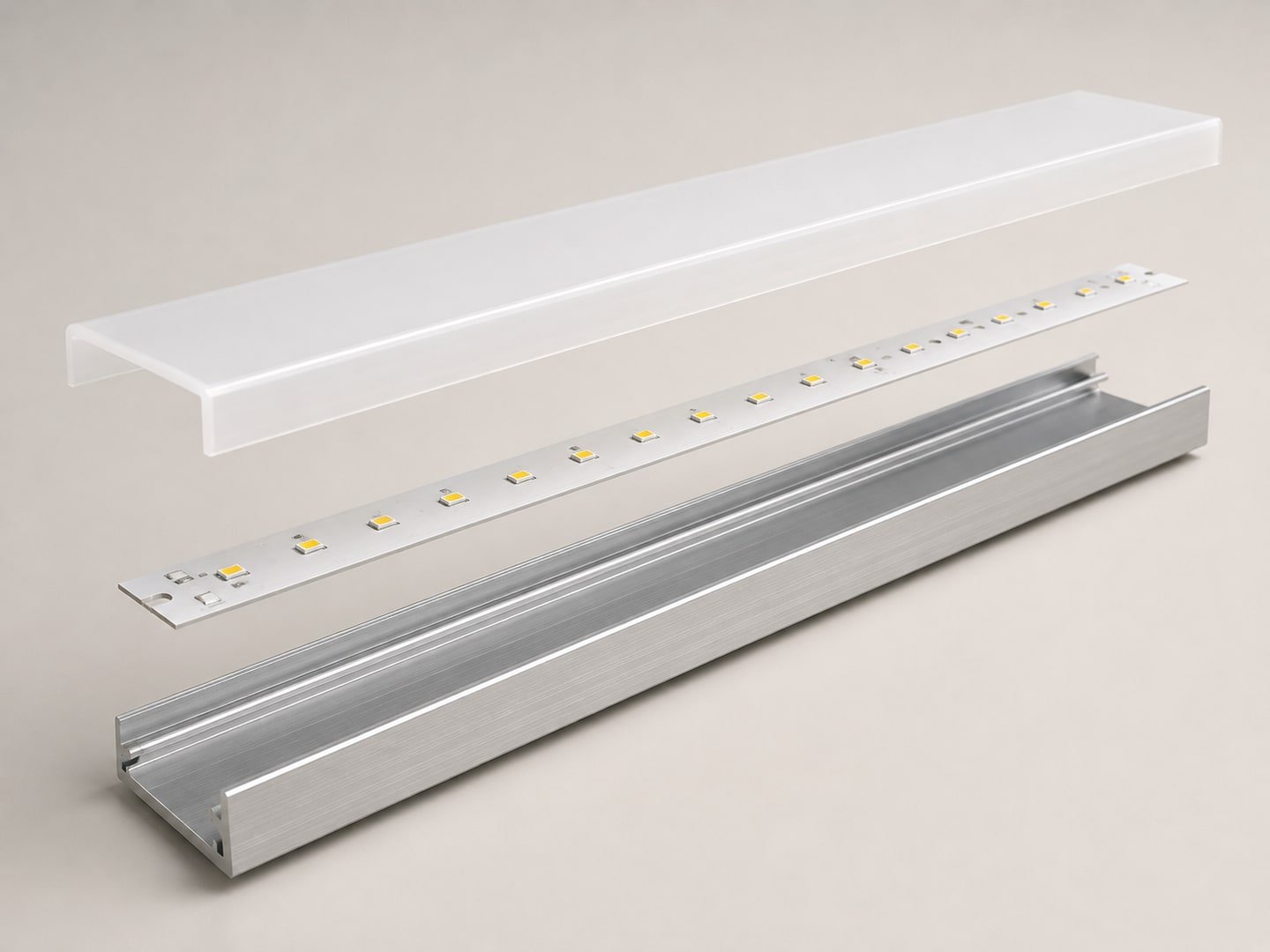
Define the boundary of the adapted product. Who selects the new components? Who verifies thermal and electrical performance? Who assembles and tests it? What documentation identifies the final configuration? A successful prototype does not by itself settle responsibility for a production batch.
Prefer interventions that can be inspected and serviced. Permanent changes may be necessary, but the team should understand how they affect future disassembly and component replacement.
A documented example helps separate these routes. In ARC’s account of The Loop in Düsseldorf, Studio De Schutter combined decorative luminaires reused without modification, existing fixtures that were upgraded and visually adapted, and new lighting where reuse could not meet the brief. That mix preserved a design intention without making every fitting follow the same route. This is the designer’s project account, not a Felix case study or a quantified lifecycle comparison.
Route 3 — replace selectively
Replacement may be justified where condition is poor, critical evidence is missing, performance cannot meet the brief, or adaptation would create disproportionate technical risk. That does not require replacing every part of the installation. Housings, mounting structures or selected luminaires may remain useful even where other elements change.
Record why replacement was chosen and what happens to removed assets. Reuse elsewhere, parts harvesting, refurbishment and material recovery are different routes and need separate practical arrangements.
The service process also matters. Signify’s remanufacturing process separates feasibility assessment, agreement on responsibilities and the inspection, assembly and testing work. It illustrates the decisions a project team needs to resolve; it does not establish that the same service, warranty or environmental outcome is available from Felix.
A mixed-route example
Consider a hypothetical office refurbishment with three lighting families. Decorative pendants in the reception area still suit the intended atmosphere. Ceiling luminaires in the work area have housings that fit the retained ceiling, but their light engines and controls need assessment. A newly enclosed meeting room has a different layout and lighting task from the former open workspace.
The initial shortlist could therefore retain the reception pendants subject to inspection, prototype an adaptation of the work-area luminaire, and compare suitable replacements for the meeting room. That is a planning example, not a report of a Felix project. The choices remain provisional until the evidence for each family is reviewed.
The value of the example is the separate decision record. A failed adaptation trial in one family should not erase a sound reuse case elsewhere. Equally, the appeal of retaining an existing housing should not conceal a failure to meet the new task, maintenance or control requirement.
Build a documented decision matrix
For each luminaire family, score or describe:
- condition and safety evidence;
- ability to meet the future lighting brief;
- compatibility with controls and emergency requirements;
- service access and replaceable components;
- architectural or heritage value;
- intervention, testing and installation effort;
- disruption to the building;
- ownership of design, testing and warranty decisions;
- end-of-use route for removed parts.
The matrix should show evidence and uncertainty, not hide them inside one total score. A low-confidence assumption can change the route after inspection or prototyping.
Assign evidence to the people who can provide it
| Decision item | Evidence and responsibility to agree |
|---|---|
| Existing condition | Asset survey and specialist inspection; identify who authorises further use. |
| Adapted configuration | Component list, retained parts, prototype and test scope; name the organisation responsible for the modified assembly. |
| Lighting performance | Evidence for the proposed configuration and room; have the project lighting team assess the result. |
| Delivery and maintenance | Recovery losses, storage, programme, spare parts and future access; agree these with the contractor, supplier and operator. |
| Acceptance | Written approval tied to the actual configuration; record warranties and exclusions offered by the responsible parties. |
This is a project coordination aid. It does not assign legal responsibility by itself. Recolight’s remanufacturing discussion describes why identification, assessment and appropriate testing are integral to placing a remanufactured product back into use; the applicable obligations need competent assessment for the project and market.
Compare the same service, over the same period
A lower purchase price and a lower environmental impact are different conclusions. CIBSE’s TM66 overview explicitly places operating efficiency within a wider product life-cycle assessment. A comparison that counts only electricity can miss retained materials, transport, processing and future replacement; one that counts only retained material can miss operating needs.
For procurement, compare options serving the same rooms, tasks and assumed service period. List survey, careful removal, transport, storage, prototype work, component replacement, testing, reinstallation and maintenance where relevant. Keep quantities actually recoverable distinct from quantities originally installed. If the evidence is incomplete, state which input could change the preference instead of publishing a carbon-saving percentage.
Before approving adaptation, identify the next replaceable component and the route to obtain it. Retaining a housing once has limited value if the newly installed light engine or driver immediately recreates a maintenance dead end.
Questions for the project team
Ask for the existing drawings, schedules and maintenance history. Identify representative units for inspection. Agree the performance brief before developing an adaptation. Decide which tests are required and who accepts them. Finally, document the approved configuration so future maintenance teams know what they are working on.
For the replacement or adaptation package, use the luminaire cutsheet checklist and, where a profile interface changes, the custom-profile RFQ checklist. The project team should retain responsibility for the overall reuse decision and validation of the completed luminaire.
Discuss Profile and Interface Requirements: outline which parts are being retained, what must change and what documentation is available. Ask Felix to confirm the scope it can support; this enquiry is not a promise of a luminaire remanufacturing service.
Featured image: concept illustration.

