A custom LED profile enquiry can begin with a sketch, but a dependable quotation needs a defined technical and commercial scope. The supplier must understand the cross-section, critical interfaces, material and finish, order quantity, secondary work and the way samples will be approved.
Sending these inputs together makes quotations easier to compare. It also exposes decisions that are still open before tooling, sampling or production is discussed.
The minimum RFQ package
Prepare one controlled package containing:
- a dimensioned 2D cross-section;
- a 3D model if the profile forms part of a complex assembly;
- the LED board or strip envelope and its location;
- diffuser, end-cap, bracket and cable interfaces;
- material and surface-finish requirements;
- critical and general tolerances;
- cut lengths and estimated quantities;
- holes, slots, tapping, milling or other secondary work;
- sample and inspection expectations;
- packaging, labelling, delivery location and target programme.
Give every file a revision and date. Identify which values are fixed and which may be adjusted after manufacturability review.
Distinguish a concept enquiry from a production quotation
If you have only a sketch, say so and identify the dimensions that are known. An early feasibility response can be useful, but the assumptions must remain visible. Profile Precision Extrusions’ RFQ guide contrasts incomplete and ready-to-quote drawings and asks for critical dimensions, visible surfaces, finishing and fabrication information. That is a more useful benchmark than sending a photograph and requesting a price “for the same profile”.
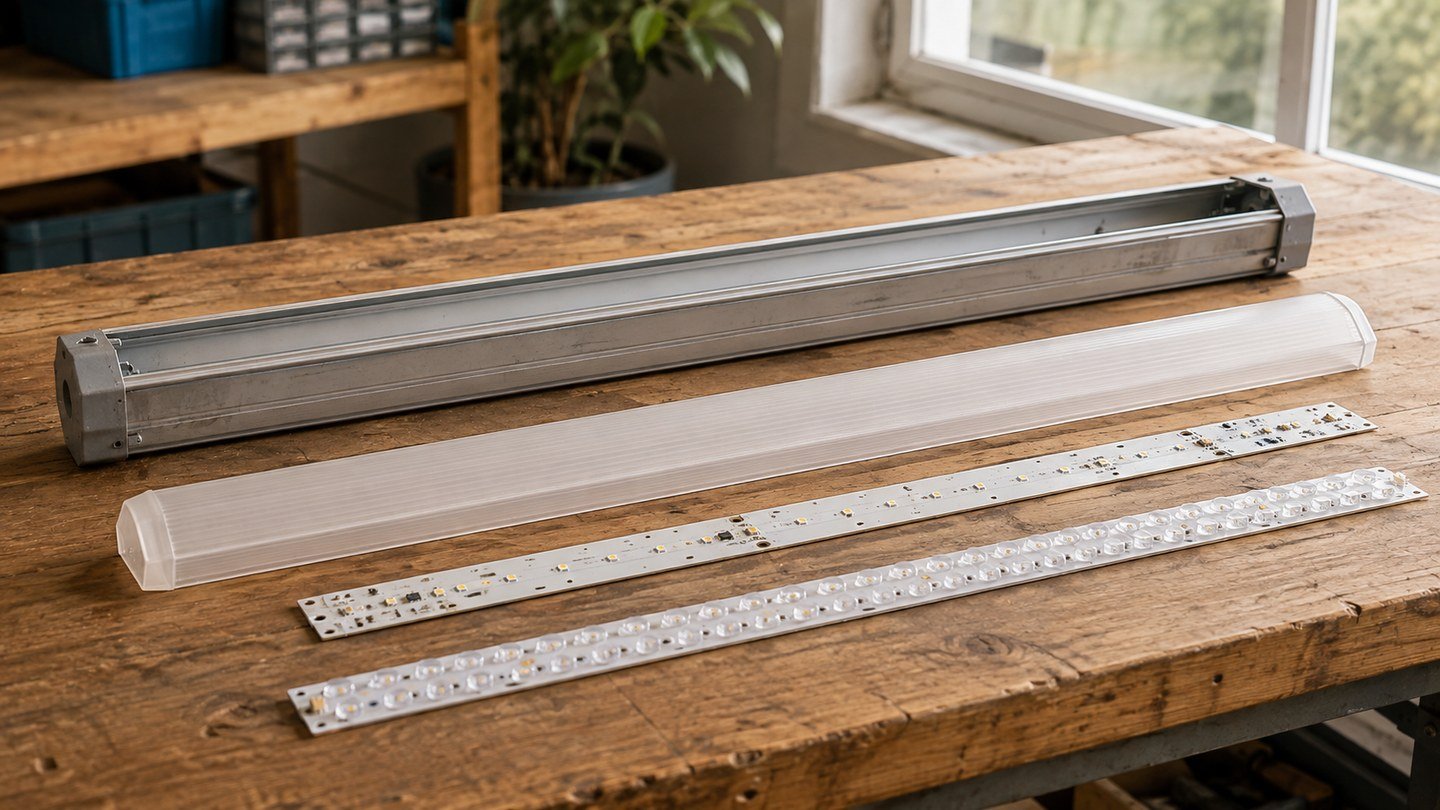
For an LED channel, distinguish the aluminium extrusion from the complete supplied package. The diffuser, end caps, clips, brackets, suspension parts and light source may be separate items. State which are included in the enquiry and provide references for the mating parts. A quote for the extrusion alone cannot be compared directly with a quote for an assembled luminaire.
Cross-section and interface data
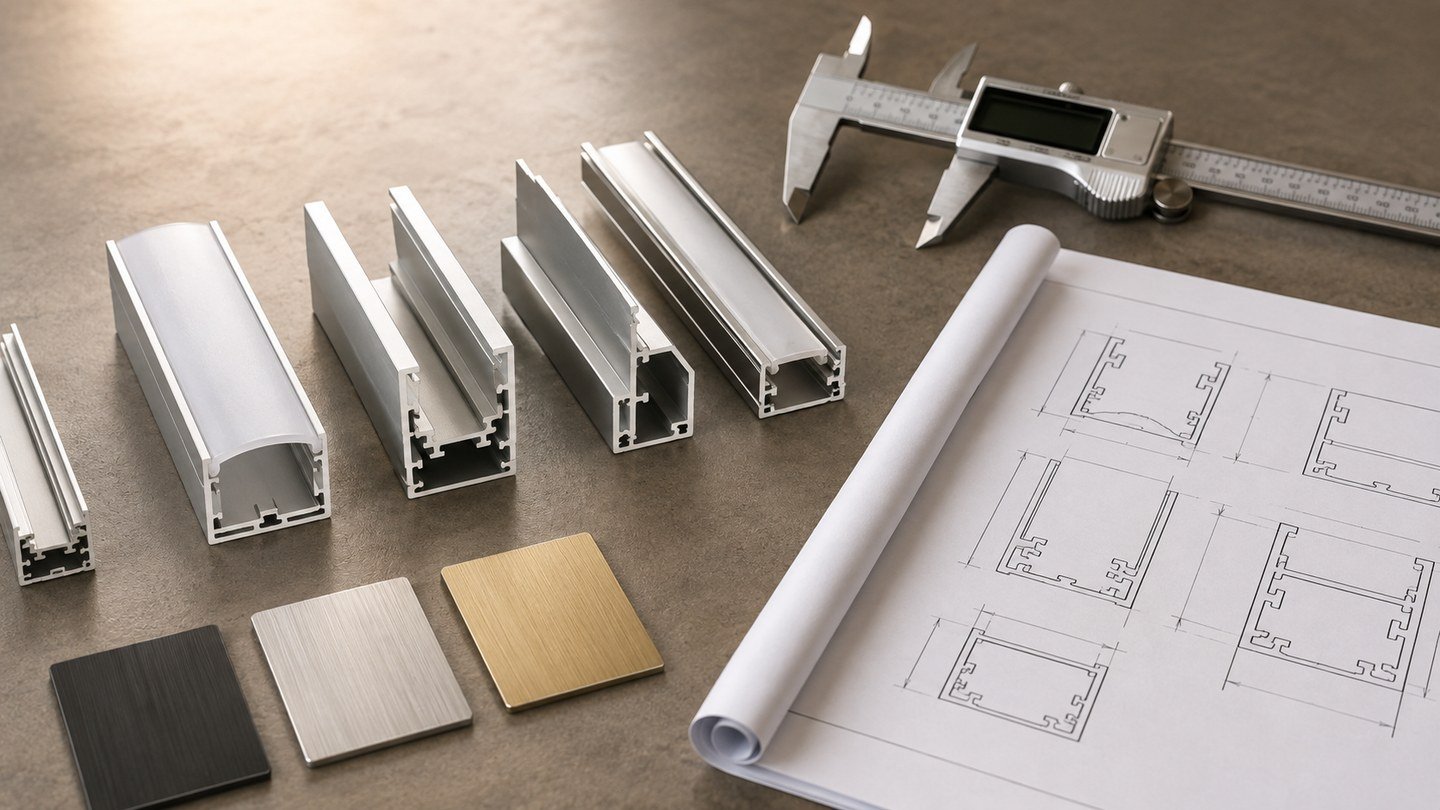
The cross-section is the centre of the request. Dimension the overall envelope, wall features, channels, grooves and mating surfaces that control the assembly. Show how the light source, diffuser and accessories locate rather than sending unrelated component drawings.
Mark functional interfaces. Examples include a diffuser snap feature, board-support surface, bracket engagement, visible reveal or alignment face. If the profile must fit an existing ceiling or product, provide the mating geometry and allowable clearance.
Avoid asking the supplier to infer scale or critical dimensions from a rendering. A rendering can communicate design intent, but it does not define an extrusion.
A cross-section is the starting point, not the finished-part definition
The example section drawing below is from existing Felix profile documentation. It illustrates why geometry must be readable: the overall envelope, internal seating geometry and intended mating arrangement are different information. The drawing identifies that profile; it does not establish a new custom part’s material, finish, tolerances, cut length or price.
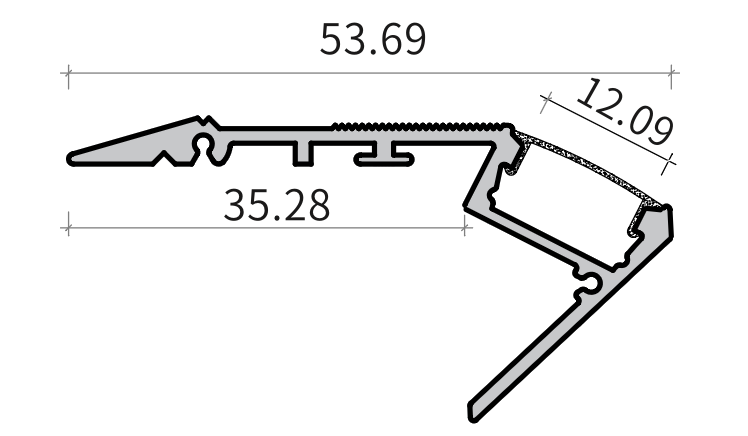
Add a finished-length view for holes, slots, mitres and end details that do not appear in the cross-section. Mark the parts of the profile that touch or locate a diffuser, bracket or adjacent surface. Where a requirement is not yet defined, label it for review rather than filling in a plausible dimension.
Keep drawing and model revisions together. SASA’s drawing guide highlights units, controlled revisions and the distinct roles of PDF drawings and CAD models. If their geometry conflicts, identify which document governs and resolve the discrepancy before asking a supplier to release tooling.
Material, finish and tolerances
State the required material or performance need and ask the supplier to confirm a suitable available specification. Do the same for finish: define colour reference, gloss or texture expectation, visible surfaces and acceptable variation where these matter.
Separate critical tolerances from general dimensions. A tight limit may be necessary at a snap-fit or alignment interface, while another surface may have more freedom. Applying the tightest tolerance everywhere can distort the commercial comparison without improving function.
Do not assume that an alloy, finish, tolerance or colour is available because it appears in a general catalogue. The quotation and approved sample should record the agreed route.
Quantity, cut lengths and secondary work
Provide realistic annual and batch quantities, not only a long-term forecast. List cut lengths and the mix between them. State whether bars can ship in standard lengths or must arrive cut, deburred and ready for assembly.
Call out every secondary operation: holes, slots, countersinks, threads, machined ends, cable exits, markings or inserted hardware. Include position tolerances and a drawing for each finished variant. If left vague, one supplier may quote raw extrusion while another quotes a finished component.
Give the target dates for drawing review, sample approval and production delivery. Felix must confirm tooling, minimum quantity and lead time for the specific design in writing; this guide does not set universal values.
Samples, inspection and packaging
Define what the sample is intended to prove. A raw section may check geometry. A finished sample can check colour and texture. An assembled sample may be needed for diffuser fit, board clearance, mounting and visual alignment.
List the measurements or visual criteria that will determine approval. Agree how revisions are recorded after the first sample. For production, state inspection documents, traceability, protective film, separators, carton limits, labels and any restrictions on contact with finished surfaces.
Compare what each quote actually includes
Ask suppliers to separate tooling or development charges from the recurring part price, and identify which operations, accessories, inspection and packaging are included. Formal Metal’s secondary-machining guide shows why holes, threads, end finishing and inspection belong in the original scope. They should not become surprises after a basic extrusion price has been accepted.
| Quote line | Confirm before comparing |
|---|---|
| Tooling and development | What is supplied, ownership or use terms, revision assumptions and trial approval. |
| Finished part | Drawing revision, material requirement, length, machining and finish included. |
| Accessories | Diffuser, caps, clips and brackets; quantity and whether supplied fitted or loose. |
| Approval and delivery | Sample condition, inspection record, packing, quantity unit and destination assumptions. |
When reviewing a sample, state whether approval covers a raw extrusion or the finished, machined and coated part. Fit that depends on the finished condition should be assessed in that condition. Record any accepted deviations against the drawing revision so the purchase order does not quietly revert to an earlier assumption.
One-page RFQ checklist
Before sending the enquiry, check that the package answers six questions:
- What is the controlled profile geometry?
- Which interfaces and tolerances determine function?
- What material, appearance and finish are required?
- What quantity, length mix and secondary work are included?
- How will the sample and production parts be accepted?
- How must the finished profiles be packed and delivered?
For wider project context, see the Felix guide to custom linear lighting and the linear luminaire cutsheet checklist.
Copy this enquiry structure
The following is an editable intake example, not a Felix minimum order or production promise. Replace bracketed items with known requirements; leave open decisions explicitly marked.
- Application and scope: [where it is used]; [extrusion only / finished profile / assembly]; [included accessories].
- Controlled files: [drawing number, revision, date and units]; [matching CAD filename]; [mating-part references].
- Critical requirements: [fit features and acceptance limits]; [visible faces and finish reference]; [open items requiring feasibility review].
- Supply quantities: [sample quantity]; [first-order quantity and unit]; [finished-length schedule]; [repeat demand if known].
- Approval and delivery: [finished sample and inspection scope]; [packaging]; [delivery destination and requested date]; [person authorised to approve revisions].
A useful response should confirm the understood scope, flag unsupported assumptions and identify information still required. If the response changes a material, finish or critical interface, record the alternative explicitly before proceeding.
Request a Custom Profile Review: summarise the drawing revision, interfaces, quantities and delivery needs in the contact form. The page also lists an email address for sharing the drawing package. Ask Felix to confirm feasibility, available processes and quotation terms in writing.
Checklist basis: the file and scope fields are consistent with the profile-extrusion RFQ guidance under “What files do I need for a profile extrusion quote?”. They are enquiry inputs, not a declaration that Felix offers every process or tolerance listed.
Featured image: concept illustration.